
 UAE
UAE  Saudi Arabia
  USA
USA Portable AC vs Evaporative Cooler: The Difference and Which to Pick
Compare compressor portable ACs that cool and dehumidify with evaporative coolers that add moisture. Choose for your local climate and budget in Egypt.
We may earn a commission from purchases through our links, at no extra cost to you. Full disclosure.
Start with the listing’s specifications: does it show a compressor, refrigerant and exhaust hose, or a water tank and cooling pad? Make that check even when the title says “desert cooler” or “portable AC”. Here, desert cooler means an evaporative cooler; the sales name alone is not enough to identify the appliance.
The difference that shapes the decision
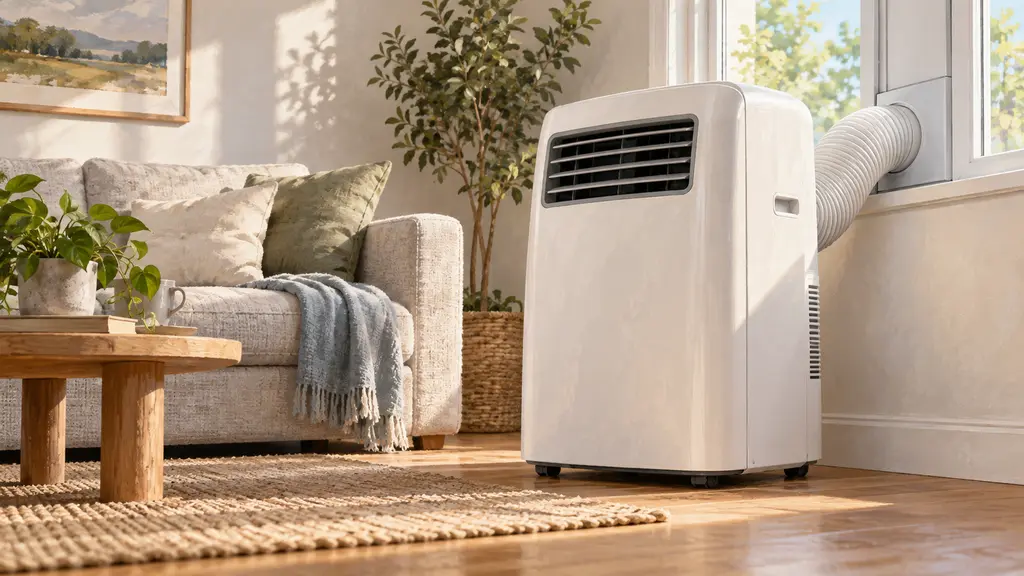
A refrigerant portable AC uses a compressor and an exhaust hose to vent heat outside. An evaporative cooler uses a water tank and wet pads, without an exhaust hose. The US DOE Energy Saver guide, page 17, describes evaporative cooling as suited to hot, low-humidity air, with warmer air pushed out through windows as cooled air enters.
| Check | Evaporative cooler | Compressor portable AC |
|---|---|---|
| Identifying specifications | Water tank and cooling pad | Compressor and refrigerant |
| Air outlet arrangements | Check the manual’s ventilation requirements | Exhaust hose to the outside |
| Sizing | Check listed airflow, coverage and rating conditions | Check cooling capacity and the maker’s room-sizing guidance |
| Upkeep | Check water-refresh, tank and pad instructions | Check filter and water-handling instructions |
Price: compare the actual models
The Ocean 12,000 BTU Portable Air Conditioner card shows ≈ 19,990 EGP, with its recorded check date. Do not use a fixed price threshold to identify either technology, or calculate running-cost savings without data for the two models.
See the Ocean price on Amazon.eg ↗
Before buying
- Start with the room’s conditions: for a cooler, check whether they fit the DOE’s hot, dry climate guidance. Window access alone is not the decision.
- Check the setup: for a portable AC, read the manual’s hose and window-kit fitting and sealing instructions. Check dimensions and weight if you plan to move it between rooms.
- For a bedroom: look for a published noise figure and its operating speed. Do not assume either type is quieter.
- Check upkeep: use the exact manual for cleaning and water handling, rather than a universal schedule.
For models, see the best portable AC in Egypt. For the wider decision, read how to choose a portable AC and portable AC versus split AC.
About this guide
- Editing
- Mizaan Home editorial team
- Last updated
Research based on published specifications, without hands-on testing. How we choose
Prices are checked per product; the oldest check on this page:
This analysis is based on published information from Amazon.eg.
Frequently asked questions
How do I identify a portable AC versus an evaporative cooler?
Check for a compressor, refrigerant and exhaust hose, or a water tank and wet cooling pad. Do not identify the technology by the listing title or price alone. The Ocean card on this page is a compressor AC example.
Does an evaporative cooler suit Egypt?
Start with conditions in your room. The US DOE Energy Saver guide describes evaporative cooling as suited to hot, low-humidity air, with warmer air leaving through windows. An open window alone does not establish suitability.
How large is the price difference?
The Ocean card on this page shows ≈ 19,990 EGP. Compare that with the cooler you are considering at purchase time; this page has no carded cooler price from which to calculate a reliable gap.
Which costs less to run?
Check each exact model's consumption and your intended hours of use. The category name and purchase price alone do not establish the bill difference.