
 Egypt
Egypt  Saudi Arabia
  USA
USA What Size Microwave Do You Actually Need?
Choose microwave capacity by measuring your dish, lid, turntable and cavity. Litres and household size alone cannot establish whether a container fits.
We may earn a commission from purchases through our links, at no extra cost to you. Full disclosure.
Choose a microwave by the dishes that must fit and the space the installed appliance needs. Liters are a useful label, but they do not tell you whether your dinner plate, casserole handles, or food cover will clear the cavity and door.
Measure the dish, not the household
Measure the widest dish you regularly reheat, including handles and its cover. Check the usable cavity dimensions, turntable diameter, and clearance above the food. On a turntable model, the complete dish must rotate without hitting the walls. A rectangular container can be more restrictive than a round plate of similar width.
Do not assume that every 20-liter microwave fits the same plate or that 25 liters automatically serves a family. Two households with the same number of people may use different dishes and batch sizes. Ask for the exact internal measurements when they are absent from the listing.
Allow for installation and daily access
Measure the appliance’s width, depth, and height with the door opening path. Add the ventilation clearances from its installation manual. A freestanding countertop microwave must not be treated as a built-in model simply because it fits inside a cupboard.
Samsung’s UAE support guidance includes ventilation and the model manual among heating checks. It does not provide one universal clearance for all microwave types. Use the dimensions and installation requirements of the unit you intend to buy.
Capacity and cooking power answer different questions
Capacity concerns space. Microwave cooking output concerns heating power. Electrical input on a label is not the same measurement as cooking output, so compare like-for-like figures rather than assuming the largest watt number heats fastest.
Choose the modes you need separately: ordinary microwave reheating, grilling, or a specified convection function. A larger cavity does not establish a grill or convection capability. Check the utensils permitted in each mode; an accessory suitable for grilling is not automatically suitable for a microwave-only cycle.
Use the UAE shortlist carefully
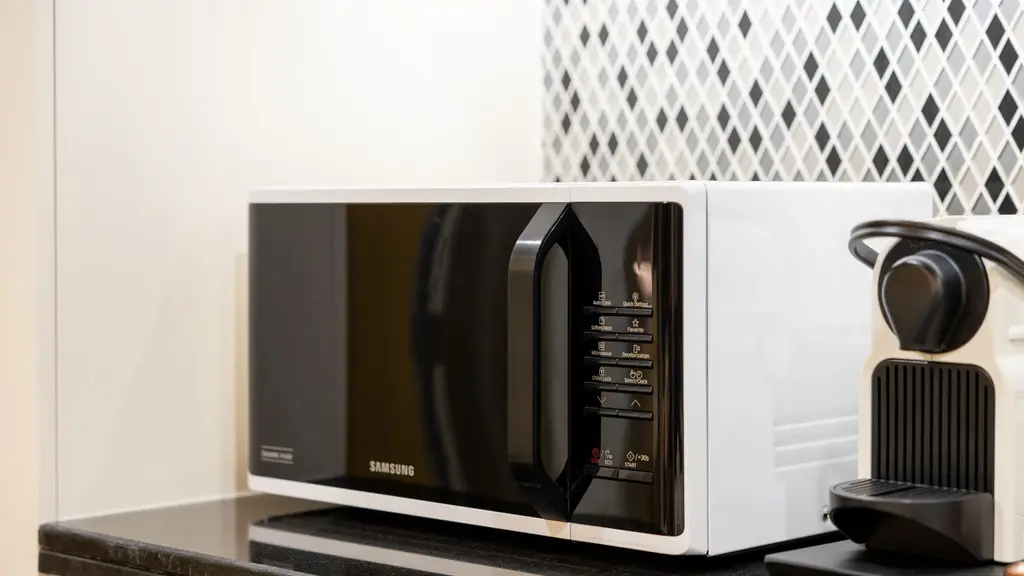
The Samsung 23-liter card is a selected option, not proof that every dinner plate fits. Compare its exact cavity and turntable with your own dish. If a smaller model meets those measurements and the required functions, extra liters may add bulk without helping your routine.
Use the UAE microwave shortlist and microwave prices after measuring. How to choose a microwave covers controls, modes, and the wider purchase checks.
About this guide
- Editing
- Mizaan Home editorial team
- Last updated
Research based on published specifications, without hands-on testing. How we choose
Prices are checked per product; the oldest check on this page:
This analysis is based on published information from Samsung UAE: Microwave Heating and Ventilation Support, as of 5 October 2026.
Frequently asked questions
Is 20 liters enough for two people?
Household size alone does not decide it. Check your actual dish, cover, usable cavity, turntable, and batch routine.
Does a 25-liter microwave fit every dinner plate?
No. Cavity shape and turntable clearance vary. Measure the whole dish and handles and confirm it can rotate where required.
Can a countertop microwave go in a cupboard?
Only if its installation instructions permit that arrangement with the required clearances. Physical fit alone is insufficient.
Does more wattage mean a bigger or better microwave?
Compare microwave cooking output separately from electrical input and capacity. Each describes a different feature.